
Choosing Speed Without Losing Sight of Value
Executive Summary
Following a period of acquisition, a private equity-backed consultancy group needed to establish a common operational platform across five specialist consultancies.
The strategic priority was speed: create visibility, consistency and a shared operational foundation quickly enough to support the Group's ambitions.
Rather than treating software implementation as the end goal, the programme deliberately separated implementation from operational maturity. Go-live would create immediate operational value, while the longer-term objective would be to build the operating capability required to realise that value consistently over time.
The Challenge
Each business entered the programme with different ways of delivering projects, forecasting work, governing delivery and reporting performance.
Waiting until every operating process had been redesigned would have delayed the wider strategic objectives, yet implementing too quickly risked exposing inconsistency and operational ambiguity.
The challenge wasn't simply implementing a Professional Services Automation (PSA) platform.
It was making the right strategic trade-off for the Group at that point in its journey.
Every Implementation Is a Strategic Choice
One of the biggest misconceptions surrounding PSA implementation is that there is a single "right" approach.
In reality, every implementation is a strategic trade-off.
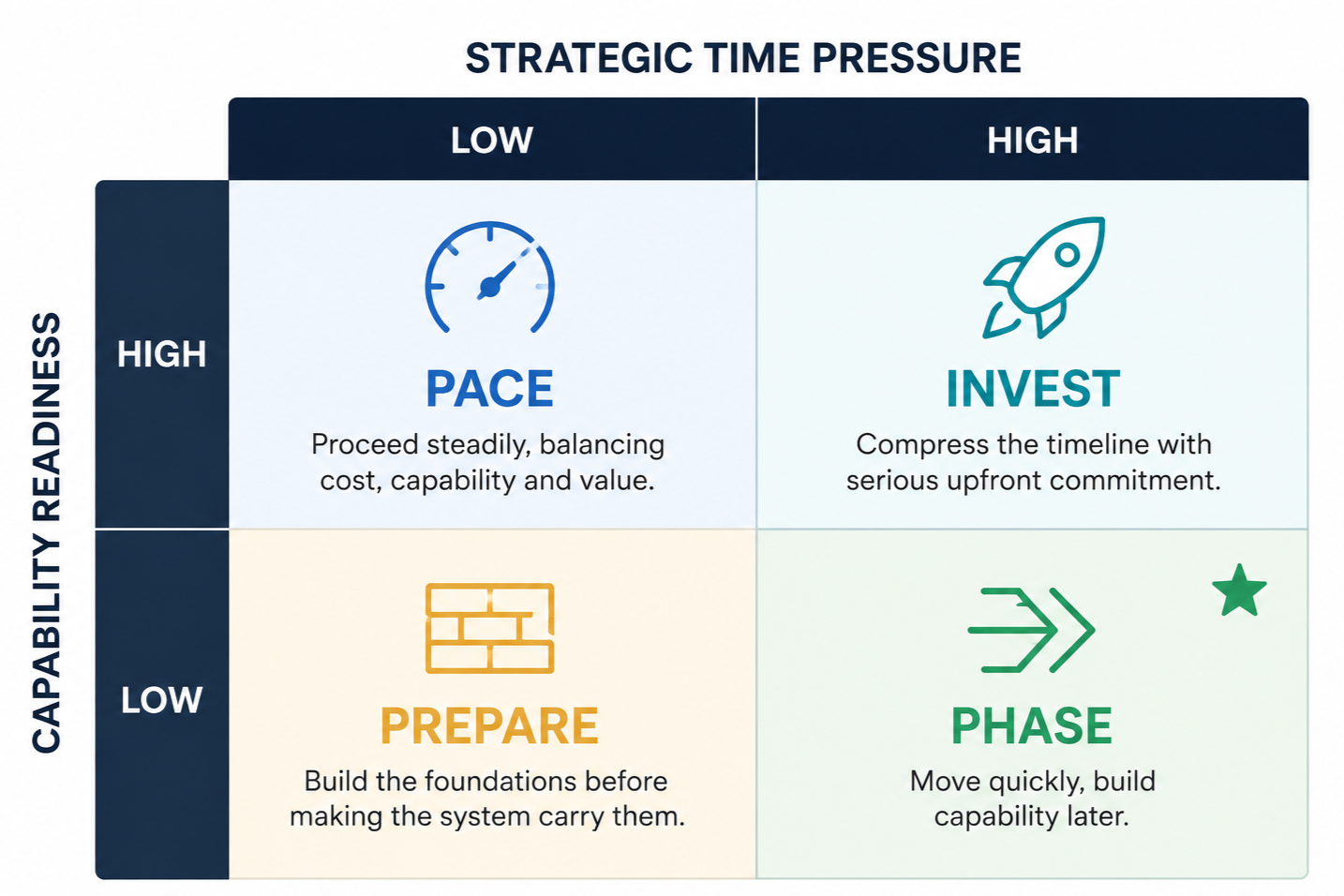
Before defining an implementation strategy, I assess two factors:
- Capability Readiness
- Strategic Time Pressure
Together, these determine which implementation approach is most likely to protect long-term value.
Why This Programme Chose PHASE
Following a period of acquisition, the Group faced genuine strategic time pressure.
Leadership needed to establish a common operational platform across five businesses quickly in order to improve visibility and create consistency across the Group.
At the same time, each business had different levels of operational maturity.
Rather than delaying implementation until every process had been redesigned, leadership consciously chose the PHASE strategy.
This wasn't an accidental compromise.
It was a deliberate strategic decision that balanced the need for speed against the reality that operational capability would continue to develop after go-live.
Given more time, I would typically recommend building greater capability readiness before implementation.
However, consulting isn't about applying the same methodology to every client.
It's about helping organisations make the right strategic decision for their circumstances.
Phase One — Establishing the Platform
The first phase focused on creating a common operational foundation across the Group.
This included:
- Onboarding five consultancies onto a common PSA platform.
- Supporting live project migration.
- Aligning finance and operational reporting.
- Establishing governance foundations.
- Improving operational visibility for leadership.
The objective wasn't operational perfection.
It was to establish the platform from which better operational performance could be built.
Phase Two — From Implementation to Operational Maturity
Go-live created immediate operational value.
The Group gained:
- Better operational visibility.
- More consistent project information.
- Stronger operational control.
- A common operational platform across five businesses.
However, the greatest commercial value isn't created by the software itself.
It is realised over time as the organisation develops the operating capability needed to make consistently better decisions.
Today, the programme is focused on:
- Defining what "good" looks like.
- Embedding operational governance.
- Improving forecasting confidence.
- Developing leadership dashboards.
- Strengthening commercial reporting.
- Creating consistent operating disciplines across every business.
The platform provides capability.
The operating model determines how much value the organisation ultimately captures from that capability.
Building Capability for the Next Acquisition
Perhaps the most important outcome of the programme is that it is improving tomorrow's acquisitions as much as today's businesses.
The first five businesses required the Group to build:
- Governance
- Operational standards
- Leadership reporting
- Dashboards
- Review rhythms
- Operating disciplines
Those capabilities now become reusable assets.
The ambition is not to remain in PHASE.
The ambition is that future acquisitions begin much closer to INVEST.
The need for speed will never disappear.
But the Group's capability readiness will be dramatically higher.
Future acquisitions should therefore be able to move quickly without sacrificing the operational capability needed to realise value from day one.
Lessons Learned
Every implementation strategy is a trade-off.
There is no universally "correct" implementation methodology.
The right approach depends on the organisation's strategic priorities.
Go-live creates immediate operational value.
Long-term, repeatable value comes from the operating capability built afterwards.
Software enables capability.
The operating model determines whether that capability becomes commercial value.
Capability compounds.
The greatest return on an implementation programme is often realised through the capability it leaves behind for future growth.
Every improvement made today reduces implementation risk tomorrow.
Final Thought
The objective was never simply to implement software.
It was to build the operating capability that allows every future acquisition to integrate faster, adopt more consistently and realise value sooner.